easy macrame bracelet tutorial

Macrame Bracelet Tutorial Samples

I’ve been so wanting to do a tutorial and I finally decided on this cute little macrame bracelet. It’s based on the knotted bracelets you see in tourist shops. They’re very simple to make and depending on the cord and beads you choose, you can design them to suit your style. They also make great gifts because of the somewhat adjustable length on the sliding clasp.

Just about any kind of cord and beads will work as long as the bead holes are large enough for two cords to fit through. Only one knot, a simple square knot is used throughout. The sliding clasp is as simple to finish as the bracelet and the entire project can be done in one episode of American Idol or whatever you fancy TV wise.

You’ll need a few simple things:
  • clipboard with a piece of foamcore or cardboard cut to fit
  • 4 yards cord (I used C-Lon Tex 400 for this demo)
  • 8 or more beads depending on length of bracelet
  • 2 smaller beads for dangles
  • 3 straight pins
  • scissors
  • needlepoint needle for finishing (has a round ballpoint end)
  • needlenose jewelry pliers (optional)
Instructions

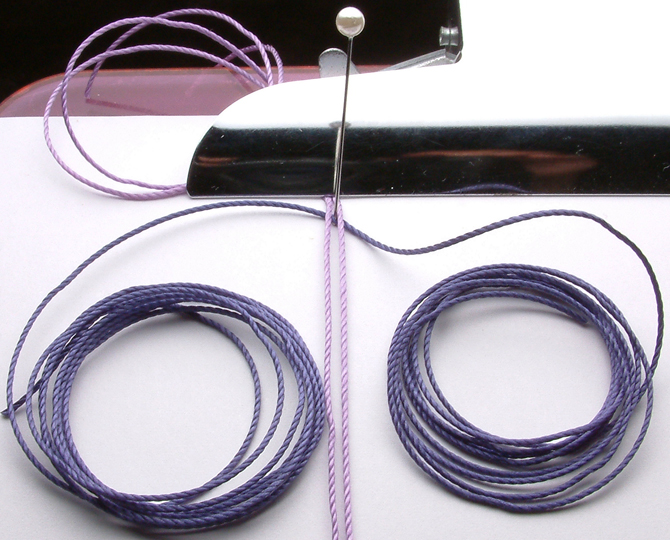
Step 11) Cut 2 pieces of cord about 24″, hold together and clip them under the clipboard about 8″ from the one end. These will be the filler cords. I’m using a shade of lavender for my filler cords.

Cut one piece of cord about 2 yards long. This will become the knotting cords. Normally I use the same color cord for both filler and knotting cords, but just for this demo I’m using a dark shade of purple for the knotting cords. Find the middle of the knotting cord, slip under the filler cords and pin to foamcore board. Now we’ll begin working square knots with the knotting cords over the filler cords.
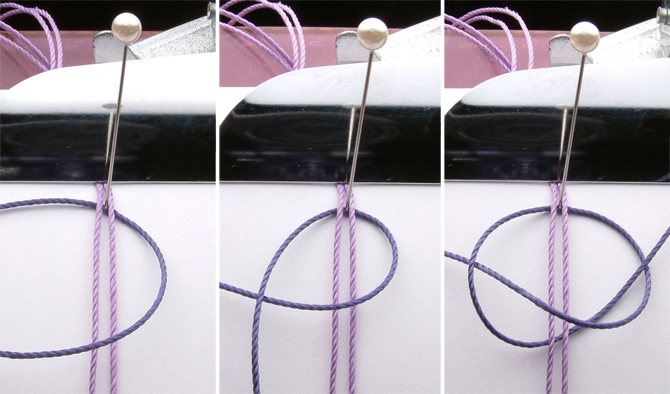
Step 22) I’m right handed so I usually start with the cord to the right side of the filler cords. Lay it over the filler cords horizontally forming a loop on right. Take left cord and place over horizontal cord, then underneath all cords and up through loop on right. Pull both knotting cords out and tight. That’s 1/2 of the square knot.
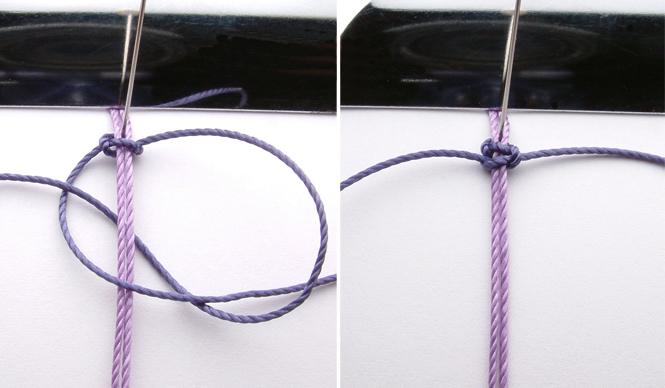
Step 33) Repeating step 2, but take the left cord and lay over the filler cords horizontally forming a loop on left. Take right cord and place over horizontal cord, then underneath all cords and up through loop on left. Pull both knotting cords out and tight. You just made one complete square knot.
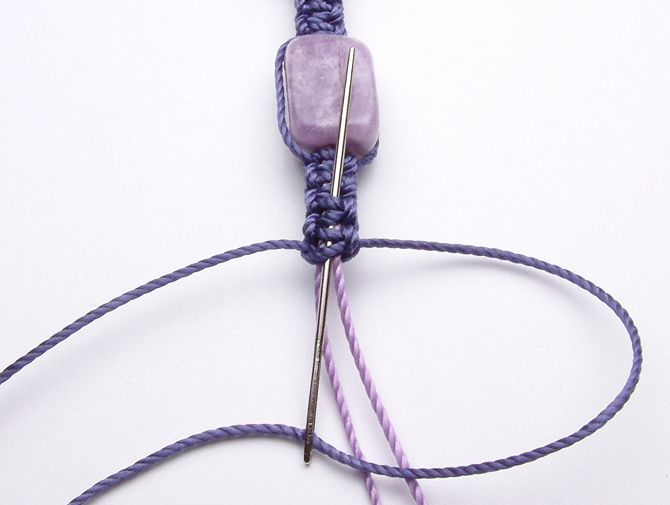
Step 44) Continue making square knots and placing a bead on the filler cords after every 3 to 5 square knots. The number of knots depends on the size of cord, the size of the beads and however many knots looks pleasing to you. Continue this pattern to the desired length. Keep in mind that the sliding clasp will add about 1/2″.

When you’re done, thread one knotting cord on to your needle and sew up the center as far as you can. If you have trouble, use a pair of jewelry pliers to pull your needle through. If you find that your knots are very tight and you cannot sew the entire cord through, unravel the 3-ply cord and sew each thread up individually. After neatly sewing up both knotting cords, trim off the excess.
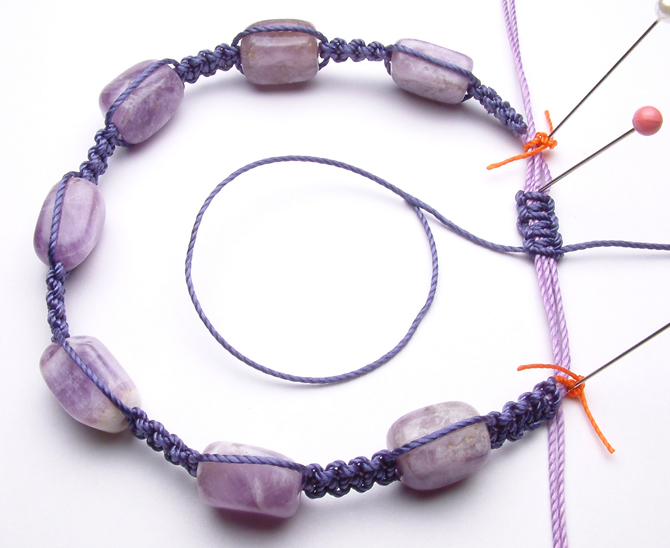
Step 55) Next we’ll make the clasp. Form your work into a circle and hold together by loosely tying with a bit of cord near both edges of knots (I used orange). Pin bracelet to foamcore.

Cut a cord about 12″ long. Just as you did in step 1, slip this cord under all four cords and work square knots over all four cords for 1/2 inch. Finish ends off just like you did with the bracelet. While sewing these ends in, be sure to avoid putting needle through the cords that are encased in clasp.
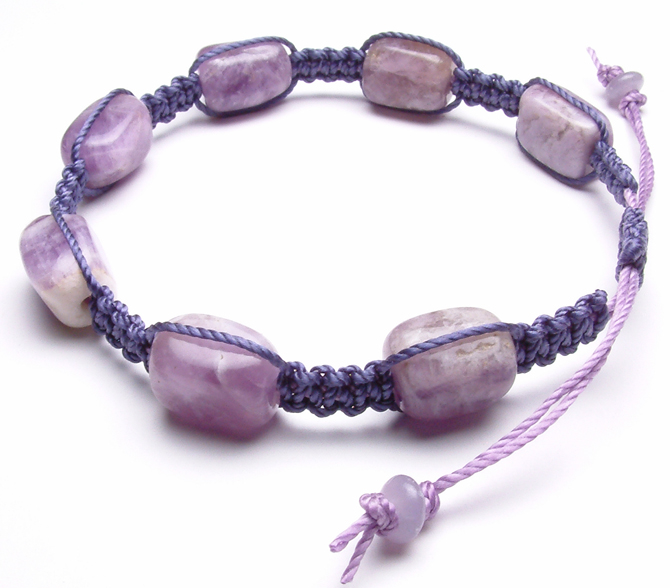
Step 66) Remove those bits of temporary cord. There are 2 loose cords coming out of each end of the clasp section. Hold 2 cords together and form a slip knot, place a bead on both cords, then form another slip knot to hold in place. Trim off the excess. Run around and show off to everyone you know.

If you have any questions, please let me know. I’d be happy to help you. I didn’t design this bracelet, in fact I disassembled one of those inexpensive tourist versions just to see how they finished off the ends. So feel free to work up this design to your heart’s content.

Cheers, Monica

View PDF

Tags: , ,

  1. Dear Monica,

    I came across your blog and I think you make the most beautiful Jewelry. Years ago I did allot of Macrame. It looks as though the knots are the same. I am looking to make a belt and possibly straps for a purse. I am going to practice my knots using your tutorial. I am having a hard time finding the basic supplies I need to begin this project. I wondered if you ever made larger items?

    Julie
    Novi, Mi.

    Reply

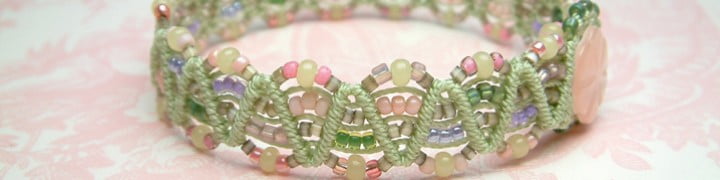
  2. Is there a pattern for the bracelet pictured at the top, its beautiful!!!

    Reply

    1. Thank you for showing me this, I’ve wanted to know for awhile how to do the connection on the bracelet. Now that I know how easy it is, I will be making them for everyone in Family, your great.

      Reply

  3. I just taught my 8 yr. old grandson to macrame using your instructions! He’s thrilled that he can “tie knots” with the best of them. Thank you!

    Reply

  4. Brilliant just made one in super quick time thanks for a great tutorial

    Reply

  5. Hi Monica,

    I am a complete newbie at jewelry making (bracelets in particular) and have recently watched a few YouTube videos in a quick attempt to learn how to make a square knot etc. With your help, I have not only learned how to make a square note, but a complete macramé bracelet. Laughing, I’m a Corporate Trainer by profession, so I truly can and do appreciate your tutorial; it was easy to follow. I am so excited by the idea of mastering this technique/style. Thank you!!!

    Reply

  6. Thanks for this great tutorial. I’ve been looking for this exact bracelet pattern for months!

    Reply

  7. I cant find the C-lon Tex 400 cord. Not at Hobby lobby, michaels or Joanns. Where do you get it or order it? I am looking for a cord that is thicker than embrodery floss but thin enough for beads!

    Reply

  8. Thanks for your great tutorial! I was a macramer years ago; belts, planters ect back in the 70s! Love the slide knot and am heading to hobby lobby to get the cording! What I would really love to learn in how to make the bracelet at the top of your page…….. the one with the small beads! next tutorial???
    jan

    Reply

  9. hi Monica

    I must admit as much as i like making things I’m not very good with following patterns. I’ve been looking for a beaded door curtain and all the ones I’ve looked at have put me of trying but after seeing your tutorial and being able to follow it so easily I’m going to try to use it to make my curtain.

    thanks Stacey

    Reply

  10. Thank you so much! This was my first try at macrame, and it was brilliant! Now made myself both a bracelet and a choker using your tutorial. Happy New Year!

    Reply

  11. Hello,

    I am a little confused on how to sew up the knots….how can this be done????

    Thanks,

    Sharon

    Reply

    1. Hi Sharon,
      If you are using a round nose needle you likely won’t pierce the filler cords as you slide the needle through. If in doubt, before pulling the cord all the way through, move the slider portion up and down a sliver. If it does not slide you have pierced through the filler cords, just pull the needle off the cord and pull the cord out. Try again. Of course this will only work with cording that is narrow enough to fit through a needle. There are times when I have resorted to using my really humongous upholstery needles on very thick cord. Especially hemp which varies a great deal in thickness.
      I hope this helps,
      Monica

      Reply

  12. Best macrame tutorial on the web. I have been trying for months to master the slide clasp and the one thing I was missing was using the needle to thread the finishing string. Oh and using the foam to hold the project in place with pins is brilliant. THANKS!!!

    Reply

  13. Hi Monica!

    Thank you so much for this fabulous tutorial! I have been looking for about an hour on the internet to find a way to finish off bracelets and none of them have made much sense to me, as I have never done macrame before! But this is really helpful and clear, so thank you!
    The thing is, I am going to be making mine in leather, so of course the thing I am worried about it the sewing back through. Do you have any ideas on how this might work? Most of the bracelet is not going to be macrame, but have a Sterling silver ring as the focal. I just thought that the macrame clasp looks so much more professional and pleasing to the eye.

    Anyway, hope you can help!

    Thanks for your time,
    Carolynne.

    Reply

    1. Hi Carolynne,
      I’m thinking this technique in leather might be a little different. I’ve never tried this but I think that if I were using leather, instead of creating a slide clasp I would snuggly thread the cords thru a sizeable slide bead and then slip knot the ends. If you’re wondering what a slide bead is, go to http://www.riogrande.com and search for “silver slide bead”.
      Hope this helps…
      Monica

      Reply

  14. Where do you find the cord at you used in the demo? I’ve always used hemp but would like to try this stuff out as well.

    Reply

    1. Hi Danny,
      The cord used in demo (C-Lon Tex 400, 0.9mm thick) was from Marion Jewels in Fiber. If your’re looking for something heavier maybe more masculine, try leather cord, or 7-ply Waxed Linen (1.25mm thick). I just happen to have quite a bit of waxed linen left over from when I used to order wholesale, which was usually from Helby Imports. Try your local bead shop or craft stores like Hobby Lobby, Michaels, and Joann’s. Don’t rule out unusual places like Tandy Leather or American Indian Pow Wows. On-line shops such as Rio Grande and Fire Mountain Gems are also good sources.
      Thanks for visiting!
      Monica

      Reply

  15. This is great. Cute bracelets. I have been wanting to learn how to make these bracelets with the sliding clasp. Thanks for sharing your tutorial, great pictures & instructions. Love your bracelet at the top of your page to. Really nice.
    Thanks

    Reply

  16. i tried it with normal string and it sort of twisted up.

    Reply

  17. Can you do this with normal string? By the way your tutorial ROCKS!!!!!!!

    Reply

  18. Thanks for the great instructions & pictures – VERY helpful! :)

    Reply

  19. Just got back from Mexico 4 days ago from where I purchased 10 bracelets like the one in your tutorial. My friends LOVED them, so I decided to go online to see if I could find directions on how to make them, myself. Within a few minutes, I found Smitten By a Knot and your tutorial. Thank you so much…can’t wait to make one. (I have never tried macramé before ;)

    Reply

    1. Hi Gerry,
      Or should I say Hola! Glad you found my tutorial. Give it a try & I hope you get hooked on macrame.
      Many thanks for visiting,
      Monica

      Reply

  20. hola, me gustan muchos los pulcera de macrame se como terminarlas pero como hago para que el hilo se desteja y aseguro para que el cierre no se rompa que productos o intrumentos usas para hacer el cierre y donde lo consigo . muchas gracias

    Reply

    1. Gladys,
      Gracias por los comentarios de su tipo. Estoy utilizando una aguja de tapiz. Tiene una punta redondeada. No estoy usando otras herramientas. Yo simplemente coser cada cordón hasta el centro de los nudos. Si se utiliza una cordón de nylon compuesto de 3 hilos, se pueden dividir las hilos y coser de forma individual. Al cambiar la dirección de la aguja no hay necesidad de usar pegamento.
      Muchas gracias por leer mi blog.
      Monica

      Reply

  21. Hello Monica
    I have been making bracelets with waxed cord and have such a problem finishing them.
    I usually use a bead on one end and a loop to hold the bead.
    However the beads tend to come loose.
    I am hoping I can grasp the clasps you use that would be so much easier.
    Sue

    Reply

  22. How do the ends on the slide fastener not pull back out? I am thinking glue might not work there because of the pull thru ends of the bracelet. Thank you for all the information you have posted. It is very helpful.

    Reply

    1. Hi Pat,
      It’s hard to spot in my photo. In order for the cords to stay put within the sliding clasp. #1) With waxed cord it not too much of a problem because the cords stick to each other so well. #2) With 3-Ply Nylon I separate the cords into 3 strands and work each individually, and I reverse direction at least once with each strand so they do not pull out. Hope this helps, Monica

      Reply

  23. Hola soy Roser, no entiendo como hacer la parte del cierre .Besos

    Reply

  24. Tengo problema con el ingles,podrias traducirlo.Macrame habia hecho tiempo a… pero la forma de acabarla no lo veo claro.Muchas gracias por adelantado.

    Reply

  25. Muy linda la pulsera te felicito

    Reply

    1. Nancy,
      Gracias por sus palabras buenas.
      Monica

      Reply

  26. I just came across your tutorial and I too was wondering how to make the clasp. I want to make some graduations gifts for my daughters friends (40-50) next year so I need to use something that will end up only costing less than 50cents or less. Could you use embroidery floss and not use such large beads? These will be for girls and guys.

    Also thanks for the great close up pictures

    Reply

    1. Hi Pat,

      Sure, you could definitely use embroidery floss and smaller beads as long as your beads holes are large enough to accommodate the floss. These bracelets do lend themselves to any gender. Have fun with this idea!

      Cheers, Monica

      Reply

  27. Thank you so much for this tutorial! I can’t wait to give a whirl.

    Reply

  28. Hi Monica,

    I’ve been looking for instructions on how to do a slide clasp, but because I didn’t know the name, it was hard to find any. I’m really glad I found yours, they’re very easy to follow. I appreciate your taking the time to post this tutorial.

    Thank you,
    Deborah

    Reply

  29. I’ve been looking everywhere on how to finish off this type of bracelet and you explained it so easily. Thanks!

    Reply

    1. Hello Ivonne,
      Thanks for taking a looksie here. I love all the comments, they keep me inspired to keep on.
      Monica

      Reply

  30. Monica,
    thank you so much for this tutorial! It’s very clear and easy to follow, great pictures help too! I am seeing lot of these bracelets now and wanted to make one for myself. They look really cool!
    Thanks
    Hana

    Reply

    1. Hana,
      Thanks for your lovely comment. I’m hoping to do another tutorial real soon.
      Stay tuned…
      Monica

      Reply

  31. Thank you for writing this tutorial! I’ve seen some really beautiful, elegant bracelets which I now know were made like this (pave beads, faceted beads, etc.) on the internet but could not find out how to make them! One bracelet I found looked like it was made with a satin cord, but it seems like it would be difficult to find beads with holes to accomodate that. I’ve ordered some C-Lon, and look forward to the variety of styles from fun to elegant that I think you can make with your tutorial. Thank you!

    Reply

    1. Hi Michelle,

      Thanks for visiting and I very glad to hear you’re enthused to give it a try. Speaking of bead hole sizes (she said sheepishly), perhaps I should have mentioned that the amethyst beads used for this tutorial had very small holes indeed. I used a Foredom drill with a diamond drill bit to increase the size of the holes. If you love semi-precious gemstone beads, check out the big hole beads at JBC Beads, http://www.jbcbeads.com.

      Cheers,
      Monica

      Reply

  32. Hi Monica,
    Thank you so much for sharing this great pattern with pictorials. I can’t wait to make my first bracelet.
    Thank you again!!
    Barbara

    Reply

    1. Thanks Barb,
      It’s great to hear from readers. Surely makes my day!
      Monica

      Reply

  33. This tutorial is very helpful!
    I have had the problem of my cords coming untied even when they are glued which also looks messy. When you are sewing the knotting thread back through the knots is the point to try and go straight up and through the middle coming out all the way at the opposite end? Do you ever use glue?

    Thanks so much.
    Best,
    Jane

    Reply

    1. Hi Jane,

      First of all, I’m glad you like this tutorial. Most of the time I don’t use glue, except on certain projects that are done in hemp. If I were doing this tutorial bracelet in Hemp I would dab a bit of glue on the cord before pulling all way through so that the glue travels within the tunnel that the cord is pulled through (Step 4). If I’m using glue I let my project dry overnight before wearing.

      Waxed cords really don’t need glue because the knots tend to stay put so well.

      Micro-macrame is most often worked in 3-ply nylon cord. Maybe that’s what you are using. When I’m sewing the knotting cord back through the knots I don’t go very far, maybe 5/8″ to 1″. For me the trick is to get a neat ending without raw threads showing. The 3-ply cords can be unravelled fairly easily. I almost always unravel and sew each thread individually because individual threads are thinner and you can treat just like a sewing project, changing direction (on the underside) to secure. Lastly I trim very carefully with curved embroidery scissors.

      I hope this helps you out.
      Keep knotting!
      Monica

      Reply

      1. Thanks Monica, this helps explain certain things however I am working with 1mm waxed cotton cord that is not very waxed and feels more like cotton. I am making a similar bracelet to the tutorial with the same sliding square knot. Since the cord is pretty heavy I cant quite figure out how to get the cords back through the adjustable square knots so I’ve been cutting them and gluing them. I’ll give the needle thing a try!
        -Jane

        Reply

        1. Jane,

          I forgot to mention that you could try not to pull your knots too tightly where you know you will be sewing cords back through. By the way, some techniques I learned through trial and error, some I read about in old macrame books and some are kept as samples to remind not to repeat. Have fun and thanks for reading my blog.

          Cheers,
          Monica

          Reply

  34. Can you just melt/burn the ends

    Reply

    1. Hi Monecka,

      To be honest I’ve just never caught on to that technique. Just my own preference that’s all. I don’t like the feel of the burnt ends and I worry about tightly securing the ends of pieces I sell or give away. You could try a thread burner that is specifically made for melting threads. Or you could try a hot glue gun (minus the glue). Or heat up a kitchen utensil like a knife that has a nice wooden handle and lightly touch the thread to melt. For sure you can melt/burn edges of nylon cord, but I don’t think it would work with waxed linen. For obvious reasons don’t try melting ends of hemp, cotton, or linen. Hope this helps you out. Thanks a bunch for stopping by!

      Cheers, Monica

      Reply

  35. Hello thanks for posting this tutorial. I am looking forward to getting started.
    Just a few questions before i begin.

    Does it matter what size needle i use? as long as it has a ballpoint end

    Do i have to use square/rectangular beads? i was hoping to use some beautiful daisy beads but they are round at the back were the hole is, could this work? they are made of flymo clay.

    Thanks for your time
    Look forward to hearing from you

    Reply

    1. Hello Sarah,

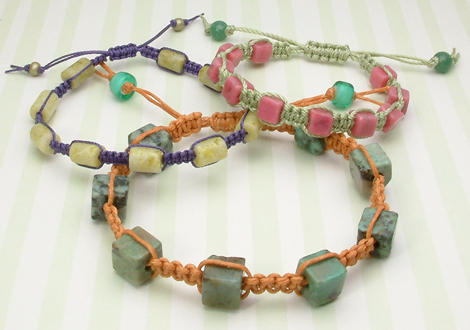
      Great to hear from you. Needle size really depends on the size of the cord you’re using. On the leading photo I used different weights of cord: Standard weight C-Lon bead cord (0.5mm thick), C-Lon Tex 400 (0.9mm thick), and 7-ply Waxed Linen (1.25mm thick). I probably used different sized needles for each bracelet. So, one thing to consider is, will cord fit through the eye of your needle?. Another is will the needle fit through the tightness of your knotting? If you are going shopping it might be a good idea to pick up a multi-size pack of needlepoint needles. Maybe if you do a little sample of square knots you can take it shopping with you and judge what needle size will work for you.

      I think the beads you are referring are perhaps shaped more like a drop bead. They might work, but I’m not sure where the knotting cords will station themselves around the bead. If there is a base for the cords to wrap around you should not have a problem. If knotting cords seem to collapse under the bead, try knotting the first square knot a bit looser.

      Have fun with this project,
      Monica

      Reply